
Spilling the beans on AI: How BeanGPT is transforming crop breeding
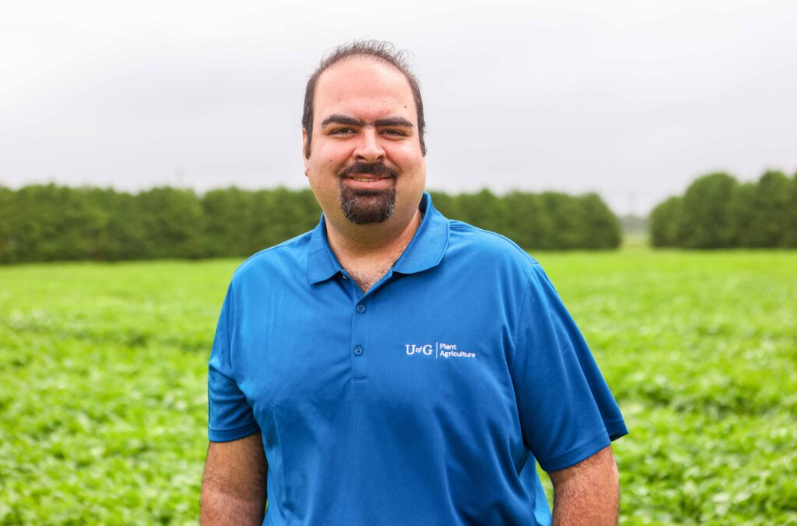
By acting as a digital research assistant, BeanGPT can scan decades of science and deliver clear, practical insights in seconds.
By Paul Adair, Staff Writer
Editor’s note: This is a reprint from the Spring 2026 issue of The Produce & Pulse Journal. Please click here to read the full issue!
Agriculture has increasingly become reliant on data, where more decisions – from planting to pollination – leans on the information being gathered in the field. Sensors buried in soil track moisture and nutrients, drones swoop over crops to map plant health, and satellite imagery weather models are helping plant breeders better understand how landscapes are changing and how crops respond. However, these technologies are also beginning to produce more information than humans can manually process.
Enter artificial intelligence (AI).
Dr. Mohsen Yoosefzadeh Najafabadi is a dry bean breeder and computational biologist at the University of Guelph’s Ontario Agricultural College (OAC), where he is using genomics, multiomics, and advanced AI tools to accelerate the development of climateresilient, highquality, highyield bean varieties. His team relies heavily on predictive and generative AI models, which have become central to their breeding program – helping them forecast traits like early maturity and quickly screen genotypes for susceptibility to diseases observed in the field.
“That got me thinking that – even though we are right now in a good place with predictive AI – how can we be taking advantage of artificial intelligence to do even more,” recalls Yoosefzadeh Najafabadi. “Let’s say I wanted to know how I can increase my yield or if I wanted to compare one bean variety I’m developing with another variety developed 20 years ago in different region of the country. It’s impossible to remember all the characteristics of all the varieties out there but, with the emergence of generative AI, I wondered if we could design and develop something to work in the background – almost as a co-breeder – to get me the answers I needed. That was the rationale behind BeanGPT.”
BeanGPT is a domainspecialized AI platform built for dry bean breeding and computational biology. It is a researchgrade large language model trained on an enormous corpus of plantscience literature and fieldtrial data, designed to help breeders, geneticists, and agronomists work faster and with more precision.
“BeanGPT doesn’t replace breeders or make any decisions on its own,” says Yoosefzadeh Najafabadi. “We still need growers to work in the field and rely on their gut experience to select plants based on their visual selection. However, BeanGPT can step in whenever their decisions become more complicated, such as choosing which line to advance or what kind of genes we need to regulate to speed up the breeding program. Instead of flipping through years of trial reports and spreadsheets, BeanGPT will handle everything for the grower all at once; almost like having a scientist on hand when you need them.”

Collaboration moves mountains (of data)
In order to design and develop BeanGPT, Yoosefzadeh Najafabadi collaborated with Kiarash Mirkamandari, a talented AI student working on his computer science at Queen’s University.
“Kiarash came to me to say he was interested in working with me because he knew I was working on the computational biology area,” says Yoosefzadeh Najafabadi. “I told him about my idea for open AI, and we started working together to make it a reality.”
BeanGPT draws on a foundation of more than 300,000 scientific papers on beans, representing roughly 100 million words of global research. It’s also fed with every available dry bean performance record in Ontario dating back to 2006, and spans navy, black, kidney, cranberry, pinto, and other key market classes. The system links directly to major public databases to pull up-to-date information on bean genetics and biology.
“The volume of data we were working with felt almost overwhelming at times,” says Yoosefzadeh Najafabadi. “Another challenge for us was that not all the papers were publicly available and, for those that weren’t publicly available, we had to collect the abstracts. It took far longer than I expected to collect everything, all of which needed to be formatted for our use.”
The platform allows users to ask questions and receive insights based on more than 20 years of collective knowledge. To accomplish this, the BeanGPT platform runs the question through eight specialized search models that cover the full spectrum of what a plant breeder might need, compares the outputs and distills the strongest evidence available, and then delivers the user a single, clear, and practical, as well as actionable, response.
“Imagine a committee made up of eight different experts on specific parts of dry beans; we built one model to pour through all the literature and peer reviewed papers, another model to look at all the publicly available data sets, another that only focused on protein, and another looking at genetics, and so forth,” says Yoosefzadeh Najafabadi. “We then have OpenAI at the centre of it all to act as a moderator, collect the information from all the other models, and then quickly transform that information into a readable answer for the user.”
Something for everyone
Because of its ease of use, BeanGPT has appeal to a broad range of dry bean stakeholders. The platform’s generative AI predicts outcomes and finds patterns and, even though some may believe that the this is most useful for research purposes, there is tremendous value in BeanGPT for anyone involved in the breeding, cultivation, or research of dry beans.
“Many farmers come to me and asking questions like, ‘Hey Mohsen, what is the performance of this variety or that variety?’ or ‘These fields are experiencing a late season drought, which cultivar would be best to use?’” says Yoosefzadeh Najafabadi. “That is all information that can now be asked of BeanGPT, and the answers you receive are not only based on internet searches, but built on decades of science and research that is then explained in a way that everyone can understand.”
The future of BeanGPT
Even though BeanGPT is currently up and running, Yoosefzadeh Najafabadi is still working behind the scenes to make it even better and more efficient. Going forward, he plans to refresh BeanGPT by adding roughly 1,000 new research papers to the platform’s database. This is an arduous task, as the publicly available peerreviewed literature still needs to be uploaded manually. However, the platform now includes an opensearch feature that will continuously scan the internet for anything else published online about dry beans – automatically pulling new information into the model.
Bean GPT is currently free and freely available to everyone, thanks to the funding and support it receives from the Research Innovation Office (RIO). This has enabled Dr. Yoosefzadeh Najafabadi to start working on new, complimentary features for BeanGPT, such as Bean Vision – a pioneering image-based classification system.
“Instead of flipping through years of trial reports and spreadsheets, BeanGPT will handle everything for the grower all at once; almost like having a scientist on hand when you need them.”
He says, “Soon, with Bean Vision, users will be able to take a picture of their seed and upload it to BeanGPT, which would then identify the seed quality and tell breeders everything they need to know about that seed based on years of science and research. We will also soon be adding a new user interface option, which is all made possible because of our partners.”
Dr. Yoosefzadeh Najafabadi’s research is the result of support and collaboration with several organizations, including the Ontario Bean Growers, Agricultural Research and Innovation Ontario (ARIO), the Ontario Ministry of Agriculture, Food and Agribusiness (OMAFA), Hensall Co-op, Agilent Technologies, Natural Sciences and Engineering Research Council of Canada, Ontario Agri-Food Innovation Alliance, Sprague Foods, the AgData Consortium, and the Research Innovation Office at the University of Guelph. Their ongoing partnership and funding are instrumental in advancing the development of smart, data-driven solutions for dry bean breeding and computational biology.
Visit www.beangpt.ca to give BeanGPT a try!


